The verdict in 30 seconds
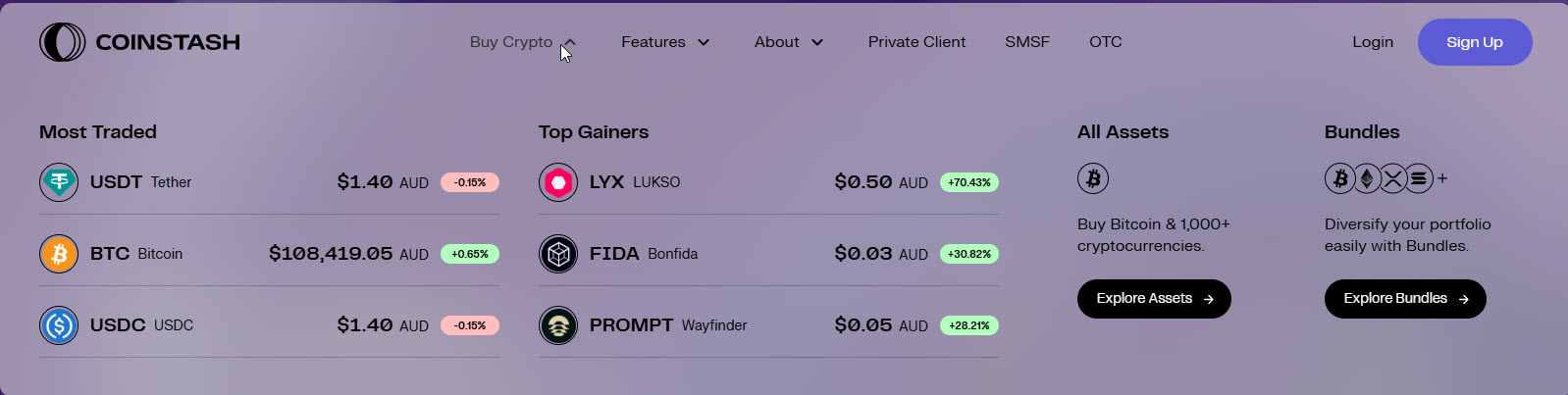
Coinstash is the right answer for one question: "what's the widest coin selection on a regulated Australian exchange?" With 1,100+ assets and a DeFi Connector reaching another 500+ tokens, it beats CoinSpot (490+) and Swyftx (410+) by a wide margin. The 0.85% base fee is mid-pack, the AFSL licence is a real regulatory plus, and Hall Chadwick audits the books annually. The downside: smaller user base (~50k) and a younger operating history mean less battle-tested infrastructure than the legacy exchanges.
What is Coinstash?
Coinstash is an Australian crypto exchange founded in Brisbane in 2017 by Ting Wang and Mena Theodorou. Operated by TWMT Pty Ltd, it serves approximately 50,000 Australian customers and has processed over A$700 million in transaction volume. The platform is registered with AUSTRAC as a Digital Currency Exchange provider and holds a wholesale Australian Financial Services Licence (AFSL) via Brindabella Investment Group Pty Ltd (AFSL No. 510735).
Coinstash's positioning is "boutique" — smaller than the legacy giants but designed for users who want broader asset choice, modern UX, and direct DeFi access without leaving a regulated platform.
Coinstash fees explained
Coinstash uses a tiered membership fee model. Most users sit on the base tier, with reductions available as you trade more volume or move through membership levels.
Trading fees
| Tier | Trading fee | Notes |
|---|---|---|
| Base | 0.85% | Default for new accounts |
| Standard active | 0.60% | Most retail traders |
| Mid-tier membership | 0.30% | Volume-based |
| Top-tier | 0% (some pairs) | High-volume or premium status |
The exact criteria for reaching lower tiers aren't always published transparently, which is a minor frustration. Most users should expect to pay 0.6–0.85%.
DeFi Connector fees
When using the DeFi Connector to trade exotic tokens, the platform aggregates the best route and gas fees in real-time. You pay:
- Network gas fees (passed through, varies by chain)
- A small Coinstash service fee on top
Total cost is typically lower than doing the same trade manually via MetaMask + bridge, because Coinstash optimises the route. The exact markup varies by token and liquidity.
Other fees
| Item | Cost | Notes |
|---|---|---|
| AUD deposit (PayID) | Free, instant | Recommended |
| AUD deposit (bank transfer) | Free | 1–2 business days |
| AUD deposit (Osko) | Free, instant | |
| AUD withdrawal | Free, instant | Via NPP |
| Crypto withdrawal | Network fee | Varies by coin |
| Card deposits | Not supported | Bank methods only |
| Withdrawal limit | $100,000/day | Higher than many competitors |
Coins supported — the unique selling point
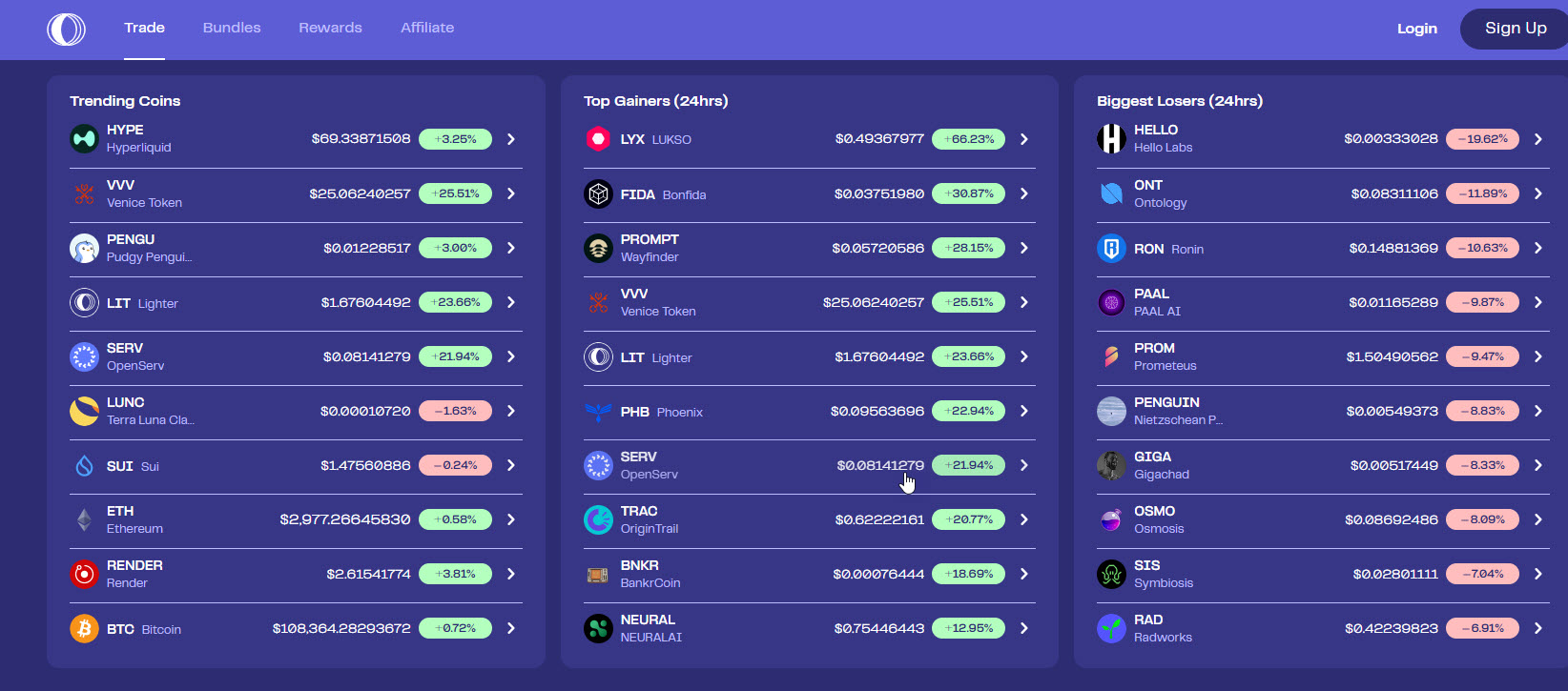
Coinstash supports 1,100+ cryptocurrencies, the largest selection of any AUSTRAC-registered Australian exchange. The platform claims to list 17 of the top 20 cryptocurrencies by market cap directly, with a few notable omissions (Lido Staked ETH, Wrapped Bitcoin, USDS).
Categories well-represented:
- All major Layer-1 blockchains (BTC, ETH, SOL, AVAX, ADA)
- Layer-2 tokens (Arbitrum, Optimism, Base, Polygon)
- DeFi tokens (UNI, AAVE, COMP, MKR, etc.)
- Memecoins (DOGE, SHIB, PEPE, BONK, WIF)
- Stablecoins (USDT, USDC, DAI)
- AI and gaming tokens (FET, RNDR, IMX, GALA)
The DeFi Connector — the other unique feature
Launched in 2022, the DeFi Connector is what really distinguishes Coinstash. It's an in-app aggregator that lets you trade DeFi tokens across 10+ blockchains without:
- Manually setting up a self-custody wallet
- Bridging assets between chains
- Searching for the best gas fees
- Holding native tokens for gas (the Connector handles this)
Supported chains:
- Ethereum mainnet
- Solana
- Binance Chain (BSC)
- Avalanche
- Base
- Arbitrum
- Optimism
- Fantom
- Polygon
- Plus others added regularly
This adds another 500+ tokens to your reachable universe through one regulated interface. For users who want DeFi exposure without the self-custody learning curve, it's genuinely useful. The trade-off: you're trusting Coinstash with custody of these tokens rather than holding the keys yourself.
Security & trust
Coinstash's security and compliance posture is solid, though not quite at the level of CoinSpot or Independent Reserve:
- AUSTRAC registered as a Digital Currency Exchange
- Wholesale AFSL holder via Brindabella Investment Group (AFSL No. 510735) — provides ASIC oversight
- Annual independent audits by Hall Chadwick, an established Australian accounting firm
- Fireblocks partnership for institutional-grade custody (same provider as Swyftx)
- Ledger Enterprise integration for additional asset protection
- 1:1 customer reserves maintained at all times
- Two-factor authentication (2FA) required for sensitive actions
- Operating since 2017 with no reported security incidents
Compared to CoinSpot, the gaps are: no ISO 27001 certification disclosed, and no Mazars-style proof-of-reserves attestation. The Hall Chadwick audit is an annual financial audit, which is meaningful but different from a real-time PoR.
User experience
Coinstash's interface is clean and modern. The platform offers:
- Web and mobile apps for iOS and Android
- TradingView-powered charts with technical indicators
- Limit orders and recurring purchases
- Crypto Bundles for instant diversification (basket buys)
- STASH Points loyalty program
Customer feedback (Trustpilot 4.6/5 from ~2,150 reviews, App Store reviews positive overall) skews positive. The platform does receive occasional complaints about account verification delays and slow live chat responses during peak periods — consistent with a smaller team than CoinSpot's.
Tax reporting (ATO)
Coinstash reports to the ATO under the Designated Service Provider regime. Tax features:
- Downloadable transaction history and EOFY reports
- Tax app integrations (Koinly, CryptoTaxCalculator)
- SMSF-specific reports
SMSF support
Coinstash has supported SMSF crypto investing since 2017 and offers:
- Same-day SMSF account onboarding
- One-on-one onboarding consultations
- Dedicated account management
- Compliance with ATO SMSF crypto guidance
Not as polished as Independent Reserve's KPMG-powered offering, but viable for SMSFs that want broader coin selection — including DeFi exposure — than Independent Reserve allows.
Pros & cons
Pros
- Australia's largest coin selection: 1,100+ assets
- DeFi Connector for 500+ additional tokens across 10 chains
- AUSTRAC registered + wholesale AFSL backing
- Annual Hall Chadwick audits
- Fireblocks + Ledger Enterprise custody
- Free, instant PayID/Osko deposits and withdrawals
- SMSF accounts since 2017
- Crypto Bundles and STASH Points loyalty program
- OTC desk for trades over $20,000
- High Trustpilot rating (4.6/5)
Cons
- 0.85% base fee is mid-pack, not cheapest
- Fee tier criteria not always transparent
- Smaller user base (~50k) means less battle-tested
- No ISO 27001 certification disclosed
- No proof-of-reserves attestation
- Live chat support quality varies during peak times
- No card deposits
- Newer platform (founded 2017) vs legacy competitors
- Only available to Australian residents
How Coinstash compares
| Feature | Coinstash | CoinSpot | Swyftx |
|---|---|---|---|
| Coins (direct) | 1,100+ | 490+ | 410+ |
| DeFi access | Native Connector | No | No |
| Base fee | 0.85% | 1% / 0.1% | 0.6% + spread |
| AFSL backing | Wholesale via Brindabella | No | No |
| ISO 27001 | Not disclosed | Yes | Yes |
| Operating since | 2017 | 2013 | 2017 |
| Users | ~50k | 3M+ | 800k+ |
| Best for | Altcoin variety, DeFi | All-round | Mobile-first beginners |
Who should use Coinstash?
Coinstash is a great choice if you:
- Want the widest selection of coins available on a regulated Australian platform
- Want DeFi token exposure without managing self-custody wallets
- Trade memecoins or smaller altcoins that aren't on CoinSpot or Swyftx
- Value AFSL-backed regulatory oversight in addition to AUSTRAC
- Run an SMSF and need broader asset choice than Independent Reserve allows
Coinstash might not suit you if you:
- Prioritise the longest operating history and largest user base — CoinSpot wins
- Want publicly disclosed ISO 27001 certification
- Want a real-time proof-of-reserves attestation
- Want the lowest possible trading fees — competitors edge ahead on fees
- Plan to deposit via credit/debit card